

Tumor Evolution Under Therapy
Treatment changes the cellular ecology of a brain tumor. We study paired and longitudinal specimens to determine how malignant clones, cellular states, and nonmalignant cells change from diagnosis through recurrence.
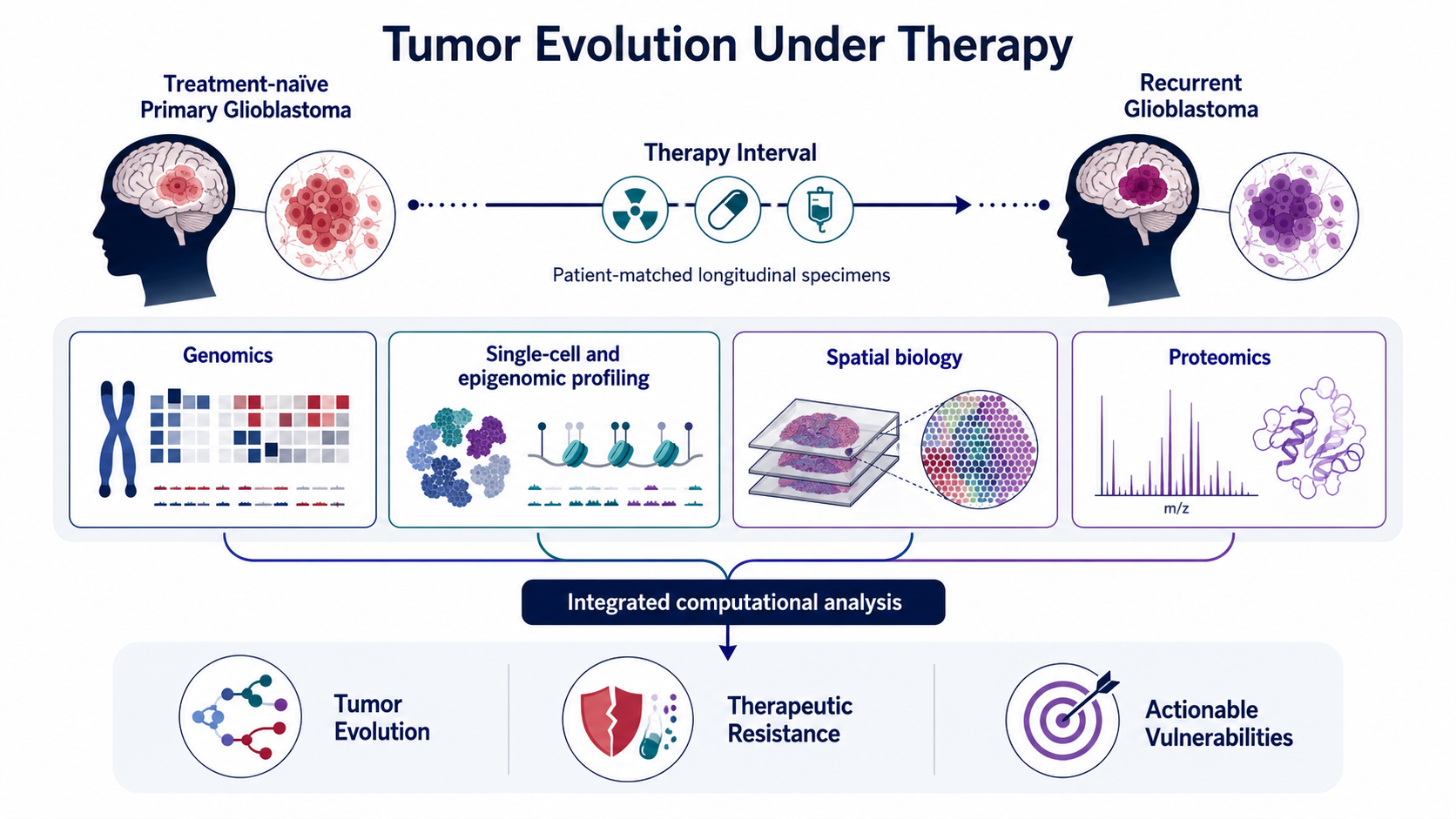
Glioblastoma evolution
Our work in glioblastoma has shown that recurrence can be driven by broad cellular-state transitions and remodeling of the immune microenvironment, rather than by selection of a single recurrent mutation. We integrate single-nucleus RNA and chromatin profiling, DNA sequencing, spatial assays, proteomics, imaging, and clinical annotation to identify mechanisms that are both biologically grounded and clinically testable.
Current directions
Current directions include longitudinal glioblastoma evolution, treatment-associated immune remodeling, and sarcomatous and hypermutated progression.
Optimizing mutant-IDH inhibition
We are integrating longitudinal imaging, clinical outcomes, and tumor genomics to determine how treatment timing and tumor genotype influence response to vorasidenib in IDH-mutant glioma. The long-term goal is to identify biomarkers and combination strategies that improve the durability of mutant-IDH inhibition.
Representative publications
- Wang L, et al. A single-cell atlas of glioblastoma evolution under therapy reveals cell-intrinsic and cell-extrinsic therapeutic targets. Nature Cancer. 2022;3:1534–1552.
- Lucas CG, et al. Longitudinal multimodal profiling of IDH-wildtype glioblastoma reveals molecular evolution and cellular phenotypes underlying prognostically different treatment responses. Neuro-Oncology. 2025;27:89–105.