

Industry and Translational Partnerships
The Diaz Lab partners with biotechnology and pharmaceutical companies, clinical trial teams, foundations, and academic consortia to translate longitudinal brain-tumor specimens into actionable biomarkers, resistance mechanisms, computational tools, and therapeutic strategies.
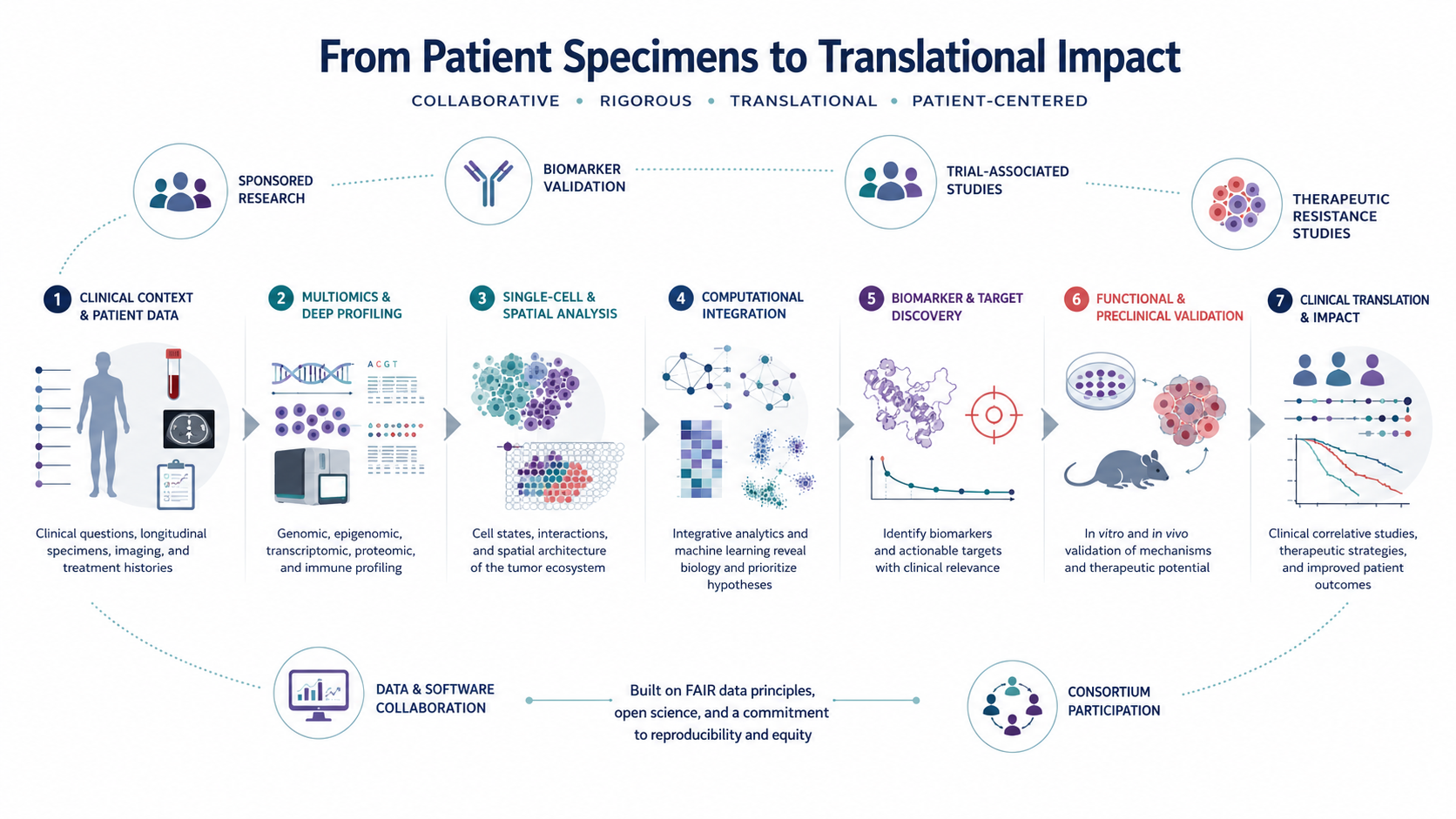
Our laboratory combines clinically grounded cohorts with single-cell and spatial genomics, lineage tracing, machine learning, and functional validation. We are particularly interested in partnerships where the central question requires understanding how tumor clones, cellular states, or the microenvironment change during treatment.
Capabilities
Longitudinal clinical cohorts. Retrospective and prospective studies using brain-tumor specimens and linked clinical data through established UCSF workflows, subject to IRB, consent, data-use, and contracting requirements.
Single-cell and spatial multiomics. Single-cell or single-nucleus RNA and chromatin profiling, spatial transcriptomics, bulk DNA and RNA sequencing, immune profiling, and integrative analysis.
Clonal evolution and lineage tracing. Experimental barcoding and computational methods that connect ancestry, genotype, phenotype, and treatment response.
Biomarkers of response and resistance. Mechanism-focused analyses of pretreatment, on-treatment, post-treatment, and recurrent specimens.
Preclinical translation. Functional genomics, patient-derived and orthotopic models, rational combination studies, and pharmacodynamic readouts through laboratory and UCSF collaborations.
Data and software platforms. Reproducible pipelines, atlases, foundation-model development, and analytic tools for complex brain-tumor datasets.
Collaboration models
Sponsored research agreement
A defined experimental or computational program aligned with a therapeutic asset, biomarker question, or disease area.
Clinical-trial correlative study
Longitudinal specimen profiling, pharmacodynamic analyses, response/resistance biomarkers, and mechanism-linked endpoints.
Translational biomarker partnership
Assay development, retrospective cohort analysis, patient stratification, or validation of a treatment-response hypothesis.
Data/software collaboration
Lineage tracing, multimodal prediction, atlas construction, model benchmarking, or integration with a partner’s platform.
Consortium participation
Multi-institutional specimen discovery, harmonized data generation, governance, and pooled analysis in brain metastasis or other rare CNS tumors.
Foundation-supported translation
Focused studies that bridge a discovery to preclinical validation, trial readiness, or an open community resource.
Current translational focus
- Brain metastasis evolution, extrachromosomal DNA, longitudinal tissue matching, and multimodal prediction.
- IDH-mutant glioma response and resistance to mutant-IDH inhibition, including treatment timing and cellular-state biomarkers.
- Diffuse midline glioma resistance to dordaviprone/imipridone therapy and rational metabolic combinations.
- Medulloblastoma cellular states, DNA-damage vulnerabilities, radiation response, and preclinical combination studies.
- RNA-splicing-derived neoantigens, T-cell targeting, oncolytic viruses, and gene-therapy combinations.
- Single-cell lineage tracing, clonal-evolution analytics, spatial genomics, and foundation models for clinically annotated datasets.
Partnership contact
For scientific or industry partnership inquiries, contact Aaron A. Diaz, PhD, at aaron.diaz@ucsf.edu.
Sponsored research, intellectual property, data use, and other agreements are coordinated through the appropriate UCSF research administration and innovation offices.