

Diaz Laboratory
Translational Genomics of Brain Tumors
We study how brain tumors develop, evolve, and adapt to therapy by integrating longitudinal patient specimens with genomic, single-cell, spatial, and computational approaches. Our goal is to identify the cellular states, evolutionary processes, and therapeutic vulnerabilities that shape treatment response and recurrence.
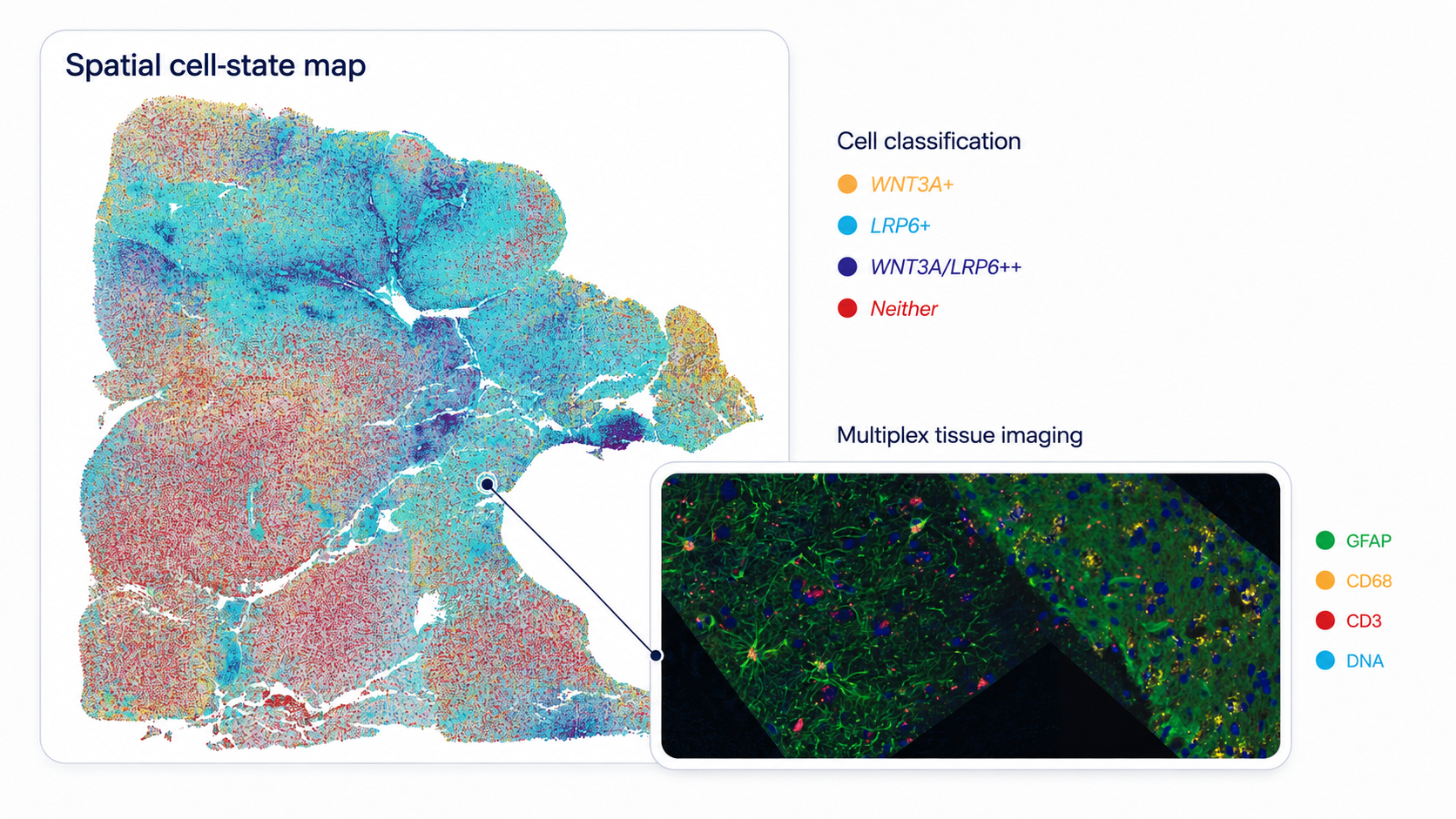
Spatial profiling links glioblastoma cell states to their immune and neural microenvironment.
View full-size illustration
Research
Tumor Evolution Under Therapy
Map genetic, epigenetic, cellular-state, and microenvironmental changes between diagnosis, treatment, and recurrence. Learn more
Lineage Tracing and Predictive Computation
Connect cell ancestry to phenotype and treatment response using engineered barcodes, probabilistic models, and multimodal machine learning. Learn more
Pediatric Brain Tumors
Identify developmental programs and resistance mechanisms in medulloblastoma and diffuse midline glioma, then test actionable vulnerabilities. Learn more
Brain Metastasis
Resolve how metastatic tumors evolve across the primary site, brain, and longitudinal recurrences using genomics, ecDNA analysis, and linked clinical data. Learn more
Tumor Immunity and Translational Therapeutics
Develop biomarkers and therapeutic strategies involving oncolytic and gene therapies, neoantigens, immune states, and rational combinations. Learn more
Current Research Highlights
Single-cell lineage and multimodal informatics
The renewed NIH/NLM R01 (R01LM013897) supports computational methods integrating cellular ancestry with multimodal phenotype, spatial context, and treatment response.
Developmental–cancer genetic convergence
The newly funded NIH/NCI R03 (R03CA309623) studies convergence between somatic alterations selected in embryonal brain tumors and rare germline variation associated with developmental disorders.
Longitudinal pediatric brain tumor biology
Longitudinal single-cell and spatial studies examine SHH medulloblastoma biology and adaptive treatment response in pediatric brain tumors.
Featured Publications
A single-cell atlas of glioblastoma evolution under therapy reveals cell-intrinsic and cell-extrinsic therapeutic targets
Nature Cancer · 2022
Integrated profiling of patient-matched glioblastomas reveals evolution under therapy and candidate vulnerabilities.
The phenotypes of proliferating glioblastoma cells reside on a single axis of variation
Cancer Discovery · 2019
Single-cell profiling defines a dominant continuum of proneural and mesenchymal glioblastoma cell states.
Single-nucleus profiling of postmortem diffuse midline gliomas identifies mitochondrial biogenesis as a resistance mechanism to imipridone therapy
Neuro-Oncology · 2026
Profiling identifies mitochondrial adaptation associated with dordaviprone resistance, motivating future combination strategies.
Measles Oncolytic Virus as an Immunotherapy for Recurrent/Refractory Pediatric Medulloblastoma and Atypical Teratoid/Rhabdoid Tumor: Results from PNOC005
Clinical Cancer Research · 2025
Clinical and translational studies characterize response and resistance to oncolytic-virus therapy.
Translational Partnerships
We welcome scientifically substantive collaborations in biomarker and resistance studies, clinical-trial correlative research, genomic, single-cell and spatial profiling, computational methods, data resources and software, and consortium participation.
Explore translational partnership opportunities
Connect with the Diaz Lab
Meet our team, explore training opportunities, or connect with our research.