

Lineage Tracing and Predictive Computation
A tumor biopsy records the cells present at one time point, but not where those cells came from or what they will become. We develop experimental and computational methods that connect cell ancestry to molecular phenotype and treatment response.
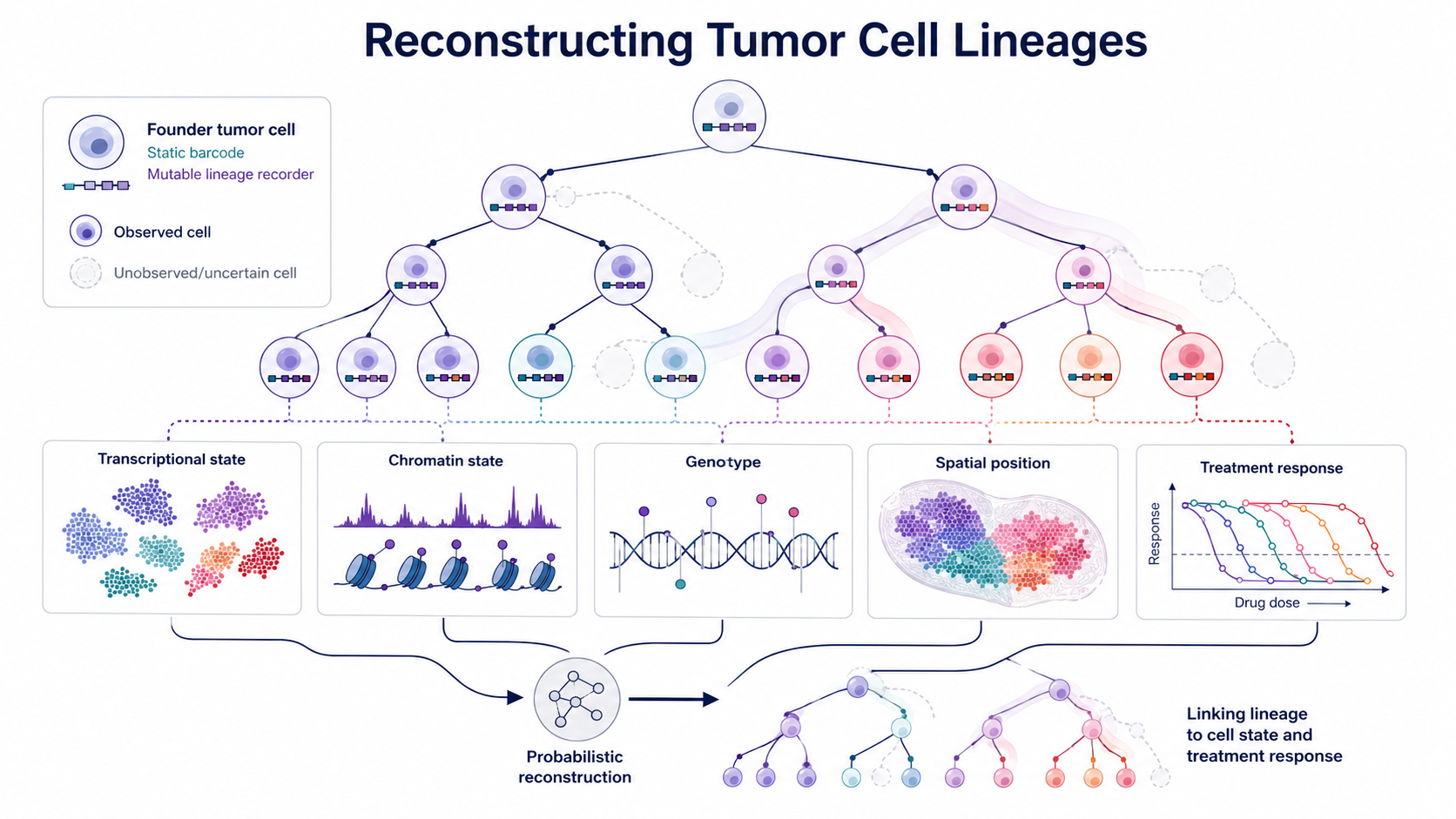
Single-cell genetic lineage tracing
Our single-cell genetic lineage-tracing program combines static and mutable barcodes with transcriptomic, epigenetic, spatial, and genetic measurements. We use probabilistic inference and machine learning to reconstruct clonal histories, quantify cellular plasticity, and identify transitions associated with therapeutic escape.
Predictive computation
These methods support a broader goal: predicting the composition and vulnerabilities of recurrent disease from measurements obtained earlier in a patient’s course. Software and reproducible workflows are released through the Diaz Lab GitHub organization when appropriate.
Software and resources
SPICE
Algorithms and code for analysis of single-cell lineage-tracing data, including estimators of cellular plasticity and clonal dynamics.
Single-cell lineage and multimodal informatics
NIH/NLM R01 — R01LM013897
An informatics framework for single-cell multi-omics from clinical specimens
Our renewed NLM program develops computational methods to reconstruct cellular phylogenies and cell-fate relationships from single-cell genomic data and to integrate ancestry with molecular phenotype, spatial context, and treatment response. The goal is to make lineage information a practical component of multimodal analysis in human tumor and model-system studies.